In Franklin Delano Roosevelt's first one hundred days as president, he proposed and Congress passed many major laws that attempted to deal with the Great Depression. Take a look at the NY Times 100 days blog, free registration required, to remind yourself about the New Deal.
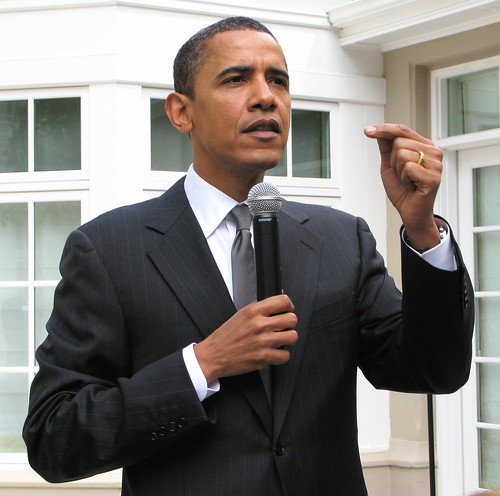
What should Obama do with his first hundred days? In 100 words (it fits doesn't it) or more, give us your opinion about the country's most pressing issue. If President Obama has begun to work on your issue, what do you think, so far? In a few days, after several people have responded, comment on another student's posting.
Important: Since this will be graded, put your first name, and last initial at the end of your posting. For your safety, do no give your complete name, blood type, social security number or anyother information that could identify you to the general public.

I believe that the most important issue tat our country needs to take care of is the economic crisis that is occurring throughout the country. What Obama needs to focus on is how to get the people that are affected deeply jobs that can help pump more money into the economy. Another issue he should deal with his how to stabilize the economy in a way that helps everybody and makes sure that banks have enough to provide if a crash ever occurs. For him to assure everybody that something like this will be solved he will have to pass many bills and hope that the money the government gives is enough. Alex Mackintosh
ReplyDeleteI think much of what Obama will have to deal with in his first hundred days has to do with the economy and what extends from the economic crisis, such as the auto and banking bailout, getting an economic stimulus passed, and mapping out a budget request for the next five to ten years. Obama needs to approve the plans that the American automakers have to have constructed by February 17th and in place by March 31st. Having received $13.4 billion in government loans to get them back on their feet, it will be important that Obama approves a sound plan proposed by the big three automakers so that they don’t fall into the same predicament they were just in. Obama has already made plans to improve the banking bailout, dubbing his new program TARP 2.0, which requires financial institutions that receive government funds, ($250-350 billion has been set aside for this new service), will have to provide greater transparency and increased updates regarding their investments and decisions, also vowing to create drastic changes such as “bad banks” where the federal government will stockpile illiquid assets that it will buy from banks. At the top of the to-do list however is to pass an economic stimulus bill through Congress, most likely the House Democrat’s $825 billion stimulus package proposition, though through his own admission, the President notes that the economy will likely get worse before it gets better, and the best he can do is attempt to keep job cuts to a minimum, and keep the unemployment rate from rising past the current 7%. Finally Obama needs to start thinking ahead, and planning the budget request for the coming years, and has already promised to have the 2010 budget request for Congress to consider by late February, though the 2009 request has yet to be passed, so that will also have to be revised this year. Overall, with the financial crisis looming much of what the President will have to deal with extends from this central issue, and it is key that he looks to the future instead of just throwing money at anything that needs it, he needs to weigh his decisions, and think about the long term effects, and then act, which he seems to be doing a good job of. Schuyler C
ReplyDeleteUnfortunately, I believe that the vast majority of Obama’s first hundred days must be spent on fixing the economy. There are many steps Obama needs to take to pull our country out of the recession, and these plans will take much longer than 100 days, but it is important that they start being implemented immediately. Obama’s primary objective should be to pass the stimulus package. This package will include both aid to states and tax cuts. In addition this bill, if passed, is expected to create or save between 3 and 4 million jobs and invest in renewable resources for the future. More importantly though, this bill would, as Obama said, "contain the kind of strict, independent oversight that will allow the American people to hold Washington accountable for how and where their tax dollars are spent." I believe that increasing accountability and transparency in all aspects of the economy is a very important goal and if done will help to stabilize the economy and make sure a similar recession does not happen again. Next, I think it is important for Obama to take on the foreclosure crisis. He plans to do this by reducing mortgage payments so that fewer responsible but financially insecure families are forced into foreclosure. Finally, Obama needs to create a long-term budget request that would outline how he plans to spend money over the next few years and exactly where the money spent will be going. This will not only help to increase transparency in government spending, but it will also make sure that money is not just being thrown at the problem, but instead being put towards well crafted and feasible plans.
ReplyDeleteMeghan Rossini
Obama's number one priority should be to take care of the economic recession that we have been experiencing for quite some time now. He has been making some strides in this issue and has taken this recession very seriously. He has proposed $10 billion to help homeowners refinance mortgages. He also intends to create mortgage credit to help struggling families. Obama also voted against repealing and cutting estate tax. The list continues but it is too early to say if these ideas will be put into action or not but so far it looks as though he could very well succeed in these issues that he wants to solve.
ReplyDeleteI strongly believe that, as our country struggles to combat an economic recession, finding ways to rebuild the economy and bring it to a level of stability should be President Obama’s top priority during his first one hundred days in office. The areas of the economy that seem to be in the worst conditions include the stock market, credit balances, housing finances, availability of loans, and social security concerns. Within the process of addressing these critical issues, the President must pass an economic stimulus program and perhaps encourage the formation of more programs of the type. By passing a stimulus program through the regulation of congress, aid could be granted to help ordinary citizens cope with credit mistakes to furthermore, prevent foreclosure. As for the stock market, rather then raise taxes, the government must limits its activity and allow the market to gradually correct itself. In order to avoid high/increasing rates of unemployment, the president must place a limit on job cuts. Also critical to the nation’s economic health, is minimizing America’s dependency on oil and imports of products manufactured in foreign country’s such as China. By manufacturing our own goods and creating new services, more jobs will be created and not as much money will be taken out of America and distributed to other countries. As these are all steps necessary to be taken to strengthen the economy, the President should also start planning for the future by issuing budget requests. Although the economy currently stands at a weak point with numerous issues to be addressed, by taking small strides and working to alleviate these issues one by one, President Obama could provide some sense of security and stability back to America’s economy. Keith R.
ReplyDeleteI agree with what Schuyler posted. She mentioned many of the topics that I talked about in my post and we seem to have similar opinions on which matters are most urgent. I most strongly agree with the sections about transparency in businesses and the 2010 budget request. As both she and I noted, this budget request will help to eliminate the waste of money and the throwing of money at problems. One factor that Schuyler mentioned that I did not was the automaker bailout. Though I agree that these companies need more government support I think it is important to note that the country must be decisive about the issue. If we are going to bail the companies out we need to be ready to spend tremendous amounts of money, and if we are not going to bail them out the money flow should stop immediately. Anything in-between will leave the country billions of dollars in debt with a failing auto industry.
ReplyDeleteMeghan Rossini
Obama has many challenges to deal with coming into the presidency after Bush. He must show the American people that he has a good plan to help us and he needs to help the country gain its confidence back. I think the most important thing for Obama to fix first is our economy. Obama already has a plan to create/save between 3-4 million jobs, which is enough to keep the unemployment rate from getting worse by 2010. Obama is also trying to fix the foreclosure problem by using a part of the $350 billion that lawmakers gave him last week. He will use about $50-$100 billion to try and reduce the number of preventable foreclosures by helping to reduce mortgage payments. Caroline H
ReplyDeleteI agree with what Joe posted. We both mentioned similar things about the economy taking precedence, but he delved deeper into issues with real estate and mortgages, and the various plans that Obama has promised to implement. Hopefully he will keep his word and will move forward with his plans because I think that there will definitely need to be drastic changes made to get real estate and mortgages back on their feet.
ReplyDeleteWith the current state of our economy, Obama needs to focus his first 100 days primarily on stabilization. However, there are other important issues that need attention too. This will not be an easy task. Creating jobs, bailing out weak companies who aren't responsible enough to run themselves properly, and an entire energy industry built around diminishing resources. He should focus his energy on the huge portion of this country living from paycheck to paycheck. Encouraging government-sponsored programs to rebuild our country's infrastructure, funding post-high school education and worker training programs, initiating community-run and staffed alternative energy programs, and providing real aid to states overwhelmed by a run on unemployment benefits are all good starts.
ReplyDelete